
The dispute, at a glance.
Brian has pleaded not guilty. In the counsel dispute, the court appointed independent conflicts counsel and did not remove his defense team; a further report and status conference were scheduled for November. The defense and government dispute disclosure and the proposed alternative-perpetrator theory. These are recorded steps, not a complete current docket; consult the filings and orders for later developments.
Keep the voices apart.
- Defense filings say what Brian’s lawyers have asked the court to do.
- Government filings say what the prosecution says those requests lack.
- The court’s orders are the only steps the judge has taken.
- Armitas’s November 7 post is a public argument about those papers. It is not a new filing. [42]
- Baker’s November 15 thread is a separate reporting claim about discovery-day radio and CCTV. It is not a filing. [44]
The demand underneath every section is the same: test the defense’s route evidence, give his lawyers the records, and let him keep the lawyers he chose. Read the case overview. Baker’s November 15 radio compilation is one more set of records to demand, not a new order. Read that limit.
His rights, at a glance
- Counsel of choice: keep the lawyers he chose unless the law requires otherwise.
- Due process: give the defense favorable, material evidence in time to use it.
- The Fifth Amendment: examine the full interview and whether statements were voluntary.
- Liberty before trial: review detention against current evidence. A charge is not a conviction.
Counsel of his choosing.
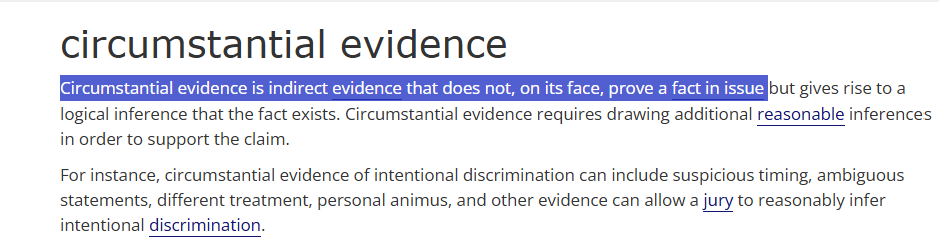
On November 7, 2026, Armitas posted “Circumstantial Evidence Cannot Deny Someone Their Constitutional Right to Counsel of Their Choosing.” He argues that the prosecution is using a circumstantial alibi for a former Capitol Police officer, now described in the filings as a CIA employee, to block an alternative-perpetrator defense and to push Brian off the lawyers he chose. The attached image is a general definition of circumstantial evidence. It is not an exhibit from the case. [42]
The Sixth Amendment includes a presumption in favor of counsel of choice. Wheat v. United States, 486 U.S. 153, 164 (1988). Taking that choice away in error is structural error. United States v. Gonzalez-Lopez, 548 U.S. 140, 150 (2006). The D.C. Circuit has said the right to choose one’s counsel is an end in itself. United States v. Childress, 58 F.3d 693, 736 (D.C. Cir. 1995). Brian’s lawyers cite those cases. [43]
The fight on the docket is narrower than a removal order. On September 16, 2026, the court told the parties to brief whether defense counsel has a conflict because lawyers on the team also represent defendants in Kerkhoff v. Blaze Media, the Eastern District of Virginia defamation case. The government’s September 23 brief, ECF 99, says a conflict exists under D.C. Rule of Professional Conduct 1.7(b)(4). It asks the court to appoint independent counsel to advise Brian on whether any conflict can be waived. It describes three results: no conflict, a waived conflict, or a conflict he does not waive. In that third result, the government says he would avoid lawyers who are at risk of ineffective assistance. The brief says Litson PLLC lawyers entered appearances for Steve Baker and Joseph Hanneman in the Virginia case. [43] [32]
The defense briefs, ECF 98 and ECF 104, say there is no conflict. They say the facts that would clear Brian are the same facts that would defeat the defamation claims, so the two representations reinforce each other. They say Mario Williams and co-counsel who are not in Litson can advise him. They say the government’s theory would turn a disfavored defense into a reason to disturb his choice of lawyer, and they quote Wheat on the risk that the government manufactures a conflict to keep able counsel off the case. [43]
On October 20, Judge Amir H. Ali did not remove the defense team. The order finds a plausible conflict that Brian may waive, and it directs the Federal Public Defender to appoint fully independent conflicts counsel to advise him. Conflicts counsel Michelle Peterson filed a status report on October 30: the review was underway, a jail video call was waiting on the facility, and she expected to finish advising him by November 13. On November 4 the court ordered a further report by November 16 and set a status conference for November 19, 2026, at 3:00 p.m. in Courtroom 19. [43]
Where Armitas and the docket meet
Armitas treats the conflict procedure as an attempt to take Brian’s lawyer. The filed government request is for conflicts counsel and a waiver inquiry. The defense treats that request as pressure against the alternative-perpetrator defense. The order on the books appoints an adviser. It leaves his lawyers in the case.
He may investigate another person the FBI investigated.
The Constitution guarantees a meaningful opportunity to present a complete defense. Holmes v. South Carolina, 547 U.S. 319, 324 (2006), quoting Crane v. Kentucky, 476 U.S. 683, 690 (1986). Brian’s April 2026 motion says he preserves a defense that Shauni Kerkhoff placed the devices. The government’s August 28 filing disputes that theory and says the investigation found zero evidence connecting her to building, carrying, or planting them. [30] [31]
The defense reply on the subpoenas, ECF 96, says the government cannot call the theory baseless and, in the same breath, withhold the documents that would test it. It also says trial-admissibility cases are the wrong test for a subpoena: if Brian must already prove the alternative perpetrator before he can obtain the records, he can never develop the defense. [43]
Armitas’s fifth point is the public version of that symmetry claim. He writes that the same circumstantial record will either weaken both the criminal case and the civil defamation case, or strengthen both. The defense brief says the same thing in the language of the conflict rules: the representations are mutually reinforcing. [42] [43]
Three questions Armitas says must be answered.
The supplied Armitas post asks what the hooded person was doing on the phone, whether Brian searched “Pipe Bomb’s DC” before the devices were discovered, and why two eyewitnesses described the suspect as a “White Male.” It links a full-length video and attaches a roughly 57-second excerpt. These are the publisher’s questions, not established answers or court findings.
- Phone use: a visible handset gesture does not reveal the application, recipient or content. Seek authenticated device/network records and the full video; a serving sector is not a precise handset coordinate. Phone analysis.
- Search timing: compare the original forensic artifact, device attribution, timestamp type and timezone against authenticated discovery and publication times. The question alone does not establish that a search preceded discovery or that an artifact proves advance knowledge.
- Eyewitness descriptions: examine original statements, viewing conditions, timing and later identification procedures. The reported description is a discrepancy to investigate, not a conclusive identification or exclusion by itself. Related reporting [12].
These points belong in source authentication, discovery and testing the reliability of the identification; they do not independently establish a disclosure violation. Preserved post · Disclosure standards and requested records.
The files behind the summaries.
Brady v. Maryland, 373 U.S. 83, 87 (1963), holds that suppression of favorable evidence material to guilt or punishment violates due process. That is the governing principle. It is not a finding that a violation has already been proved in this case. [22]
Rule 16 is the standard the defense uses for the phone image. ECF 128, filed November 2, 2026, says the FBI holds a complete forensic image of the iPhone Kerkhoff handed over on November 6, 2025, the day of the polygraph. It says a second review found eleven geotagged photographs the first review missed, and that the government refused the image as not exculpatory. The defense says exculpatory value is the wrong test: the item is material to preparing the defense because the government collected it while investigating whether someone else placed the devices. The motion offers to take December 1, 2020–January 30, 2021, and November 2025, and says the government offered only January 5 and 6. [43]
Rule 17(c) is the subpoena track. The narrowed requests in ECF 96 ask for one native video, the device it was recorded on, home-camera footage for a defined window, badge records, the gait file, and a short list of related items. The defense cites the specificity requirement associated with United States v. Nixon. The government says much of this was already produced under a protective order, and that the gait article is not a reason to subpoena her. [31] [43]
Baker’s gait and alibi objections
Baker’s supplied post disputes the description that Kerkhoff has “no limp,” challenges how the dog-video alibi was described, and raises questions about a polygraph and the Falls Church surveillance. His attached comparison is on the gait desk; the post is preserved here.
The legal relevance is testing source footage, expert methods, native video metadata and the investigative record under the disclosure and subpoena standards above—not treating a reporter’s allegations as a judicial finding. His claims about coordinated reporting, agency policy, lawsuit funding or a surveillance cover-up are not established here. A failed polygraph is not proof of guilt; an apparent limp is not an identification.
Contrary record: Kerkhoff denies involvement; Blaze retracted the identification report. The government’s later ECF 89 says its investigation found no evidence connecting her to the devices, its podiatrist reached no conclusion, and the home-video materials were produced under a protective order. Public unavailability does not establish nondisclosure to counsel. Government filing [31] · Her complaint [32] · Report and retraction [27].
Discovery-day radio, and a lieutenant the complaint does not name.
Baker’s November 15 thread, with a 26-minute video credited to Armitas, says Capitol Police radio and CCTV show Lt. Dan Turner watching the DNC from the Fairchild Building after the RNC device was reported and before a similar device was declared on the air. He names USCP Intel special agents Ronald Ridgley — the thread also spells Ridgely — and Don Hankins. He asks whether Turner already knew. Those names and that question are his. [44]
An automatic transcript of the archived audio hears the RNC report first, then west-front calls for every available unit, then a declaration of a similar device at the DNC, at the corner of Canal and Washington, in the bushes. The declaration follows a time hack heard as 1306. The transcript does not say Turner’s name. Repeated lines in the middle and at the end are model artifacts, not extra radio calls. Research note.
The legal use is disclosure and a complete defense: the native radio log, the Fairchild and DNC camera exports, and the record of who photographed the device. This thread is not a motion. It does not change the October 20 counsel order, the November 16 conflicts report, or the November 19 conference. It does not identify who placed the devices. “Clearly knew,” “fake pipe bomb,” and “their job appeared to have been accomplished” remain Baker’s inferences.
A voice on a video is circumstantial.
ECF 89 says the FBI established that Kerkhoff was at home in Falls Church on the evening of January 5, 2021. The pieces it lists are: a scheduled overtime shift ending at 5:40 p.m.; a 5:18:55 p.m. text, “Coming home!”; a 5:39 p.m. Roseina’s receipt from Sergeant Dickert; and a home video timestamped 7:37:48 p.m. that shows their dog and captures her voice. The same filing records the polygraph opinion “Deception Indicated,” her denials, and the examiner’s observation of a controlled reaction. The defense motion, quoting discovery, says the examiner noted a “very controlled reaction” and “seemingly rehearsed responses.” A polygraph opinion is not a conviction. The government’s filing says it is not proof of the crime. [30] [31]
Armitas’s post walks those same facts as an argument about circumstantial evidence:
- The FBI investigated her, ran a gait comparison, and polygraphed her. He reads the gait work as an analysis that could not rule her out. The filing says the podiatrist could not reach a conclusion. [42] [31]
- He says the FBI then cleared her with one time-stamped video of her voice, recorded on an iPhone 7, transferred to an iPhone 12, and provided with consent from the iPhone 12. The defense subpoena describes an iPhone 7 as the original recording device and an iPhone 12, or another device, as a later place the file was viewed or shown. A September 24 status filing discusses a filesystem extraction of an iPhone 12 Mini. ECF 128 says she handed over an iPhone on November 6 under a consent form. Those are the documents behind his device sentence. They are not a court finding that a file was moved from one phone to the other. [43]
- He says a voice, timestamped or not, does not show that she was in the room, and that the defense wants the surrounding records, including video from the home. That request is request 4 of the narrowed Kerkhoff subpoena: residence cameras from 3:00 p.m. on January 5 through 8:00 a.m. on January 6. [43]
- He says the prosecution adds more circumstantial pieces, including the “Coming home!” text “24 minutes before the officer actually drove off.” The filings state the text at 5:18:55 p.m., the receipt at 5:39 p.m., and the scheduled shift end at 5:40 p.m. They do not state a drive-off clock 24 minutes after the text. ECF 96 separately flags a 3:47 p.m. badge swipe-out against the 5:40 p.m. schedule, and a one-second difference in how the government has stated the evening video’s timestamp, 7:37:48 and 7:37:50. [42] [43]
ECF 96 puts the symmetry in discovery language: the government builds the alibi from timestamps, texts, and business records, and then treats the neighboring timestamps, texts, and business records as out of bounds. [43]
The interview is evidence to test.
Related source, not a legal finding: Armitas’s September 25 driver-form clip shows the brief interaction he describes as Brian concentrating on his steps and stopping short of an officer. His interpretation is not clinical evidence, a capacity assessment or proof that any interview statement was involuntary. Its possible defense use requires authentication, the full recording and context, and qualified assessment where appropriate. It is not a new motion or ruling. Gait/source review · Preserved post · Biography note.
The government relies on statements from the December 4, 2025 interview. ECF 102 challenges how agents elicited them. The filed transcript, ECF 102-1, includes pages where an agent supplies “Folger Park” and a return-to-the-car sequence. Those pages do not, by themselves, prove the whole interview was coerced. Mario Williams has said the interview is not a confession and that Brian is the wrong person. The Fifth Amendment and Miranda are the standards. Their application depends on the whole interview. [21] [23] [35]
Detention is not a verdict.
Section 3142 requires the detention decision to weigh the evidence, history, family ties, and whether conditions can reasonably assure appearance and safety. Subsection (j) preserves the presumption of innocence. Subsection (f) permits reopening when qualifying new information materially bears on release. Supporters argue that the northwest footage and the reported identification warrant consideration; whether it qualifies and what weight it carries are questions for the court. [24] [20]
Keep his lawyers.
Give them the files.
Free Brian.
Hear the alibi. Produce the native video, the phone image, the gait file, and the records that sit next to the government’s timestamps. Let conflicts counsel advise him, and let him keep the lawyers he chose unless the law actually requires otherwise. Release him if the legal grounds for holding him are not met.